

In the United States, medical devices are regulated by the FDA under the Federal Food, Drug, and Cosmetic Act (FD&C Act). Section 510(k) of this Act requires device manufacturers intending to market a device to notify the FDA at least 90 days in advance, a process known as Premarket Notification, or 510(k). This applies to Class II or certain Class I devices for the first time unless exempt, or when making modifications to an already cleared device that might significantly impact its safety, effectiveness, or intended use.
A 510(k) is a premarket submission that demonstrates that the new device is as safe and effective, or “substantially equivalent,” to a legally marketed device. This process involves comparing the new device to one or more similar devices that were legally available before May 28, 1976, have been reclassified, or have received marketing authorization through the De Novo classification.
Understanding Substantial Equivalence to a Legally Marketed U.S. Device
Substantial Equivalence (SE) is determined by comparing the new device to a legally marketed device, commonly referred to as the “predicate.” While it’s common to choose devices recently cleared through the 510(k) process as predicates, any legally marketed device that complies with the FD&C Act can serve this purpose. This means the predicate must not be in violation of FD&C Act regulations.
A device is substantially equivalent if, in comparison to a predicate it has:
- same intended use and same technological characteristics
or - same intended use and has different technological characteristics and does not raise different questions of safety and effectiveness; and the information submitted to FDA demonstrates that the device is as safe and effective as the legally marketed device.
However, if no suitable predicate can be identified, or if the new device presents distinct questions around safety or effectiveness due to different technological characteristics, the manufacturer may pursue a De Novo request. This can be initiated either after receiving a Not Substantially Equivalent (NSE) letter or by directly seeking classification through the De Novo process. For devices classified as high-risk, a Premarket Approval (PMA) may be required instead.
Types of 510(k) submissions
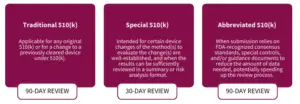
When seeking marketing clearance for medical devices, manufacturers can choose from three types of Premarket Notification 510(k) submissions depending on their specific needs: Traditional, Special, and Abbreviated.
- Traditional 510(k):
The Traditional 510(k) submission is the standard format established under 21 CFR 807. It is applicable for any new device submissions or modifications to previously cleared devices that do not qualify for expedited processes. The FDA aims to review these submissions within 90 days. - Special 510(k):
Manufacturers can opt for a Special 510(k) when making changes to their own legally marketed device. This option is suitable if the changes can be assessed using well-established methods, allowing the FDA to review the submission, often presented in summary or risk analysis format, within approximately 30 days. - Abbreviated 510(k):
The Abbreviated 510(k) leverages FDA-recognized consensus standards, device-specific guidance documents, or compliance with special controls for the device type. By aligning the submission with these recognized standards, manufacturers can reduce the amount of data needed to demonstrate SE. Like the Traditional 510(k), the Abbreviated submissions are typically reviewed within 90 days.
Despite the differences in structure and review timelines, the user fee remains consistent across all three types of 510(k) submissions.
Content of a 510(k) Submission:
Crafting a 510(k) submission requires compiling a well-organized and tabulated document as outlined in 21 CFR 807 Subpart E. A complete and thorough application is essential for obtaining marketing clearance.
While there are basic content requirements that apply to all 510(k) submissions, the specific data and information necessary to establish substantial equivalence can vary significantly depending on the type of device and the differences between the new device and its predicate. Recognizing this variability, the FDA has issued numerous device-specific guidance documents. These guidelines offer clarity on the specific data that should be included in 510(k) submissions for particular types of devices.
As each 510(k) preparation is tailored to the unique characteristics of the device in question, applicants are encouraged to consult FDA guidance documents to ensure submissions adequately address the necessary requirements for demonstrating substantial equivalence. A general structure is shown below:
- General Information:
- Medical Device User Fee Cover Sheet (Form FDA 3601)
- CDRH Premarket Review Submission Cover Sheet (Form FDA 3514)
- Cover letter
- Table of Contents (recommended)
- 510(k) Acceptance Checklist (recommended)
- Statement of Indications for Use (Form FDA 3881)
- 510(k) Statement or Summary
- Truthful and Accuracy Statement
- Proposed Labeling
- Specifications: Description of the device and a physical or technical description.
- Substantial Equivalence Comparison
- Performance data
- Additional requirements, as appropriate.
510(k) Submission and Clearance Process
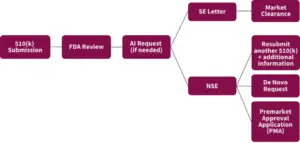
After the 510(k) submission is filed, the FDA reviews the documentation to assess substantial equivalence (SE), usually completing this process within 90 days. Should additional information be required, the FDA may issue a request for Additional Information (AI).
Upon a successful SE determination, the FDA issues an order in the form of a letter, clearing the device for commercial distribution in the U.S. This clearance allows the device to be legally marketed, contingent upon ongoing compliance with relevant regulations and postmarket requirements. These include adherence to quality system regulations (QSR), medical device reporting, and, where applicable, unique device identification (UDI) requirements. While pre-clearance facility inspections are not common, manufacturers should be ready for an FDA quality system inspection after clearance.
In cases where the device is not deemed substantially equivalent, several options are available: resubmitting another 510(k) with additional data, requesting a Class I or II designation through the De Novo Classification process, filing a reclassification petition, or submitting a Premarket Approval (PMA) application.
Any significant changes to device specifications or manufacturing processes must comply with Quality System regulation (21 CFR 820) and may necessitate a new 510(k) submission, especially if these changes could impact the device’s safety or effectiveness or alter its intended use in a major way.
At Asphalion, we specialize in providing strategic support for 510(k) Premarket Notifications, guiding your company through the complexities of the FDA submission process:
- Strategic Guidance – Develop comprehensive roadmaps and prepare 510(k) Premarket Notifications.
- Facilitate FDA Submission Process – Assist in compiling, organizing, and submitting the necessary documentation.
- Predicates Identification – Conduct thorough research and analysis to identify predicate devices.
- Engage in FDA Meetings – Accompany and represent the client in potential meetings with the FDA, ensuring all communications are effectively managed.
- Post-Market Assistance – Provide ongoing support for compliance and regulatory requirements after the product launch.
Asphalion’s Medtech unit is distinguished by its extensive experience in the medical device industry and a team of highly qualified personnel. Asphalion stands out for its adaptability and confidentiality to meet the unique needs of each company, ensuring personalized solutions that respond to specific requirements.
At Asphalion, we offer comprehensive support tailored to your company’s needs, starting from defining the scope of the quality management system to its full implementation. We develop the necessary documentation and procedures specific to each case and provide assistance throughout the certification process. Additionally, we provide ad hoc training programs that are customized to meet the specific requirements of your business. Once the quality management system is in place, we continue to support its maintenance, ensuring ongoing compliance and effectiveness.
Asphalion’s Medtech unit is distinguished by its extensive experience in the medical device industry and a team of highly qualified personnel. The unit is ISO 13485 certified, demonstrating its commitment to maintaining the highest quality standards.
Asphalion stands out for its adaptability and confidentiality to meet the unique needs of each company, ensuring tailor-made solutions that meet specific requirements.
References to FDA guidelines:
- The 510(k) Program: Evaluating Substantial Equivalence in Premarket Notifications [510(k)]. Guidance for Industry and Food and Drug Administration Staff. Document issued on: July 28, 2014
- The Special 510(k) Program. Guidance for Industry and Food and Drug Administration Staff. Document issued on September 13, 2019.